3 August 2026
Google's June 2026 Spam Update: What It Is, and Why It Is Not a Core Update
A spam update sharpens Google's spam detection and enforces its spam policies. It is a separate thing from a core update. Here is what the June 2026 update changed and how to recover.
A Google spam update is an improvement to the automated systems Google uses to detect and demote search spam. When one rolls out, Google's spam-fighting AI (called SpamBrain) gets better at spotting pages and tactics that break its spam policies, and sites that break those policies can drop sharply or disappear from results altogether. The June 2026 spam update, confirmed on Google's own status dashboard, is the latest in that ongoing programme, and if your traffic fell in that window it is the first thing worth checking.
The single most important thing to understand, and the point most business owners get wrong, is that a spam update is not a core update. They are two different systems doing two different jobs, and Google lists them as separate types of update for exactly that reason. A core update is a broad change to how Google ranks all pages on quality and relevance. A spam update is narrow: it targets policy-breaking spam specifically. Confusing the two sends businesses chasing the wrong fix, so before you change anything on your site, it pays to know which kind of update actually moved your rankings. We are Seonat, a UK agency, and we monitor client rankings through every one of these updates. This guide explains what the June 2026 spam update did, how to tell if it touched you, and what recovery realistically looks like.
A spam update is not a core update. One enforces Google's spam policies, the other rewrites how quality is judged across the whole web. The fix for each is completely different.
What Google actually changed
Google does not publish a rulebook of exactly what a spam update alters, and it never has. What it does confirm is the mechanism. In its documentation on spam updates, Google explains that SpamBrain, its AI-based spam-prevention system, is improved "from time to time" to make it better at catching spam, and that sites which violate the spam policies "may rank lower in results or not appear in results at all".
So the June 2026 update did not introduce new rules. The spam policies already existed. What changed is Google's ability to enforce them at scale: catching cloaking, scaled content abuse, doorway pages, sneaky redirects, expired-domain abuse and manipulative link schemes that previously slipped through. If a site had been getting away with a grey-area tactic, a spam update is the moment that luck tends to run out.
Spam update versus core update: the difference that matters
This is where the "core update" question comes in, and it is worth settling clearly because it decides what you do next.
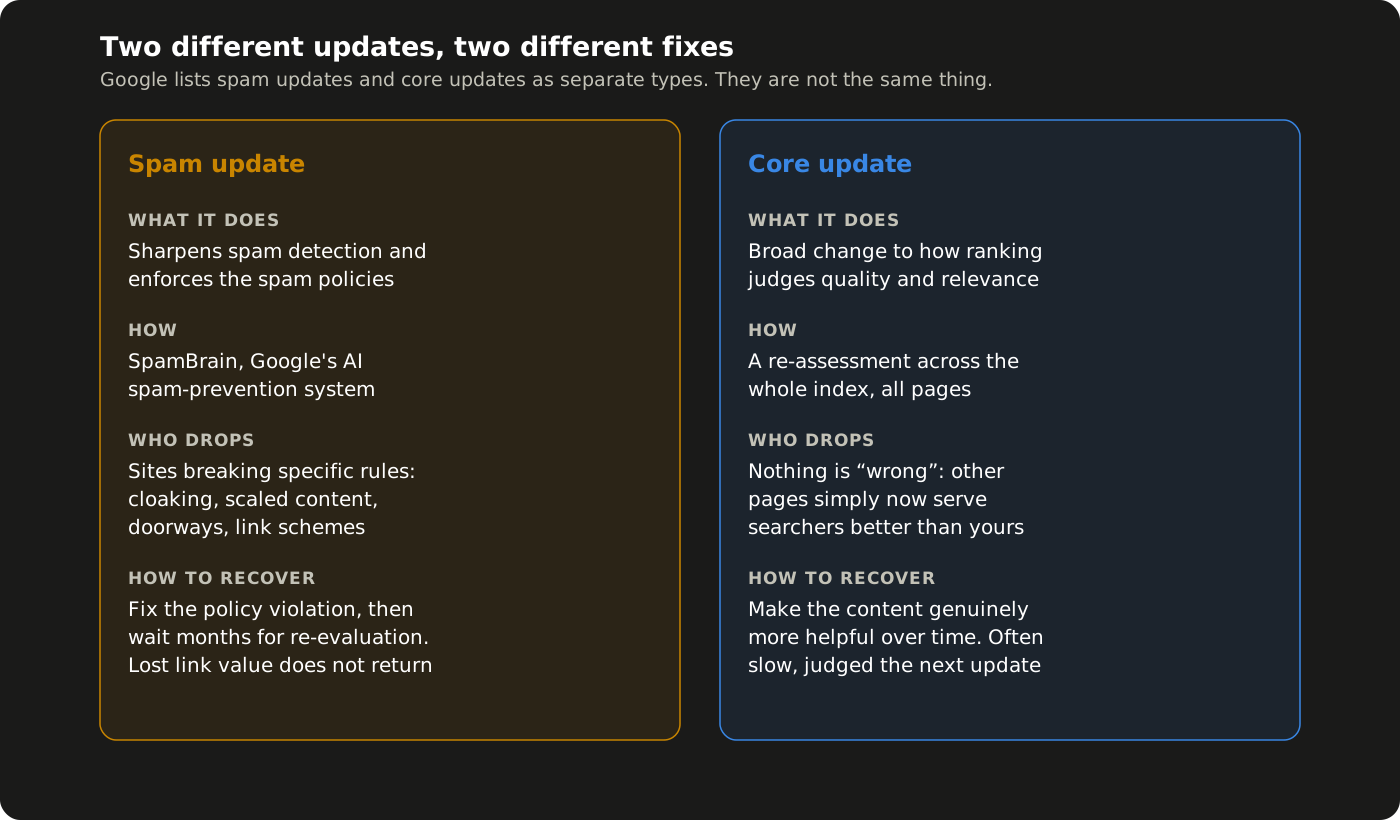
A core update reassesses quality and relevance across the entire index. If a core update drops you, nothing is technically wrong with your site; Google has simply decided other pages now serve searchers better, and the answer is to make your content genuinely more helpful over time. Recovery from a core update is about quality, and it is often slow.
A spam update is a different animal. It is not judging whether your content is the best answer. It is checking whether your site breaks specific published rules. If a spam update drops you, Google is effectively saying part of your site trips a spam policy, and the fix is to find and remove whatever that is. The two overlap in timing (Google sometimes runs a core update and a spam update in the same few weeks, which is exactly why people conflate them) but the cause and the cure are separate. In our experience, working out which system hit a site before touching anything works better than rewriting content on instinct, because a business that responds to a spam-policy problem by publishing more blog posts fixes nothing and wastes weeks doing it.
How to tell if the June 2026 update hit you
This is where Google Search Console earns its place. It is the free tool that shows you, in plain data, what Google does with your site, and it is the first thing we open when a client asks why enquiries have dropped.
Open the Performance report and look at clicks and impressions across the June 2026 update window. A spam update tends to produce a sharp, dated cliff rather than a gentle slope, and it usually hits specific pages or query types rather than everything at once. Line that drop up against the confirmed update dates on Google's status dashboard. If your fall matches the update dates almost to the day, the update is the likely cause. If your traffic was already sliding for weeks beforehand, the update is probably not your main problem, and something else deserves attention first.
From working with clients across trades, healthcare and professional services, we have found that most owners feel a traffic drop long before they can see it, and they assume the worst. Search Console turns that anxiety into a diagnosis. A genuine spam-update hit looks specific and dated. A general decline usually points to ordinary competition or a technical issue, which is the everyday work of good SEO rather than a penalty to recover from.
Do not guess from a single bad day. Match the shape and date of the drop in Search Console against the confirmed update window, then decide what actually happened.
What recovery realistically looks like
Google is unusually honest about spam-update recovery, and the honesty is not comforting. Its advice is to review the spam policies and bring your site into compliance, and it warns that even after you do, improvement comes only "if our automated systems learn over a period of months that the site complies". There is no button to press and no quick reversal. You fix the violation, then you wait for Google to re-evaluate over its own timeline.
The practical steps are unglamorous. Read Google's spam policies properly and audit your site against each one. Remove or rewrite thin, scaled or auto-generated pages that exist only to catch search traffic. Kill any doorway pages and sneaky redirects. If you have ever bought links or taken part in a link scheme, disavow or remove them, and accept that any ranking benefit those links gave you is gone for good, because Google says so directly.
One hard truth we give every client: recovery is measured in months, not days, and there is no guarantee the same rankings return even after a clean fix. That is precisely why we build client sites to comply from day one rather than repair them later. Of the twenty five or so UK businesses we handle marketing for, none has been hit by a spam update, and that is not luck. It is the difference between earning rankings through genuinely useful content and renting them through tactics that a spam update is designed to find.
What we tell clients when an update lands
Every time Google confirms an update, the same worried messages arrive, and our answer is almost always the same. First, check whether you actually moved, because most sites are not affected by any given update and panic is not a strategy. Second, if you did move, work out which system caused it before changing anything. Third, if it was a spam update, treat it as a compliance problem with a clear checklist, not a mystery.
The businesses that ride these updates out calmly are the ones that never depended on shortcuts in the first place. If your rankings come from a fast, well-built site, honest content that answers real questions, and a clean link profile, a spam update is something that happens to your competitors. We wrote a fuller explanation of that foundation in our guide to what SEO actually is, and it is the same principle every time: build to the rules and the updates stop being frightening.
Where to start
If your traffic dropped around June 2026, do not rebuild your website in a panic. Open Search Console, find the exact shape and date of the drop, and match it to the confirmed update window. If it lines up with the spam update, audit against the spam policies and start the slow, honest work of compliance. If it does not, you are almost certainly looking at ordinary competition or a technical fault, which is fixable and far less dramatic.
If you would rather have someone diagnose it properly, that is exactly the work we do. We will look at your Search Console data, tell you whether an update actually hit you, and give you a straight answer on what to fix and how long it will take. Get in touch and we will take a look with you.
Want this working for your business?
Tell us where you are now. We will come back with a clear picture of where you are losing ground online, and exactly how we would fix it.