14 September 2026
What Is Schema in SEO? Structured Data, Explained Honestly
Schema is code that tells search engines what your page means, not just what it says. Here is what it is, what it genuinely does for SEO in 2026, and what it quietly stopped doing.
Schema, also called structured data, is a piece of code you add to a web page that describes what the page is about in a vocabulary search engines read directly. It does not change anything a visitor sees. It sits quietly in the page's code and tells Google, in plain machine-readable terms, "this is a local business, here is its name, address and phone number", or "this is a blog post, written by this person, published on this date". Instead of leaving Google to work out what your page means from the words on it, you tell it, with certainty.
That matters for SEO for two reasons, and it is worth being honest about both from the start. The first is that some kinds of schema can earn you a richer listing in the results: a breadcrumb trail, a product price, review stars, an event date. The second, and in 2026 the more important one, is that schema helps search engines understand your business as a distinct entity, which feeds the knowledge panel, your logo and name in search, and the general confidence Google has in what you are. We are Seonat, a UK agency, and across three years and around twenty-five client sites we have built structured data into every website we make from the very first commit. So this guide is the honest version: what schema is, what it still does, and what it quietly stopped doing.
Schema does not change what your visitors see. It tells search engines what your page means, so they understand it with certainty instead of guessing.
What schema actually is
Structured data on the web is written in a shared vocabulary called schema.org, a project founded by Google, Microsoft, Yahoo and Yandex so that every search engine describes things the same way. It defines types (a LocalBusiness, a Product, an Article, a Person) and properties for each of them (a name, an address, an author, a price). You mark up your page using those agreed types, and any search engine that reads it knows exactly what it is looking at.
There are a few ways to write it, but the one that matters is JSON-LD, a small block of code that sits in the page separate from the visible content. Google's own introduction to structured data recommends JSON-LD over the older methods, because it is the easiest to add and maintain and it does not tangle with your page's design. In our experience, writing schema as JSON-LD works better than the older microdata approach of tagging visible HTML because it lives in a single self-contained block you can validate on its own, it is the format Google recommends, and it does not break every time the page layout changes.
The two jobs schema does
It helps to separate the two things people mean when they talk about schema, because they are not the same, and they are not equally alive in 2026.
The first job is rich results: the enhanced listings you sometimes see in Google, like the star ratings under a product, the breadcrumb path above a result, or a video thumbnail. Schema is what makes a page eligible for these, though eligible is the key word, because Google decides whether to actually show them.
The second job is understanding. Even when schema produces nothing visible, it tells Google what your page and your business are, cleanly and without ambiguity. That feeds how you appear in the knowledge panel, whether Google shows your logo and correct business name, and how confidently it connects your site to your brand. This second job is quieter, it earns no stars, and it is the part that still works reliably for almost every business.
The honest truth about rich results in 2026
Here is where most guides mislead you. They imply that if you add schema, you get stars and snippets. For most business types in 2026 you do not, and pretending otherwise sets a false expectation.
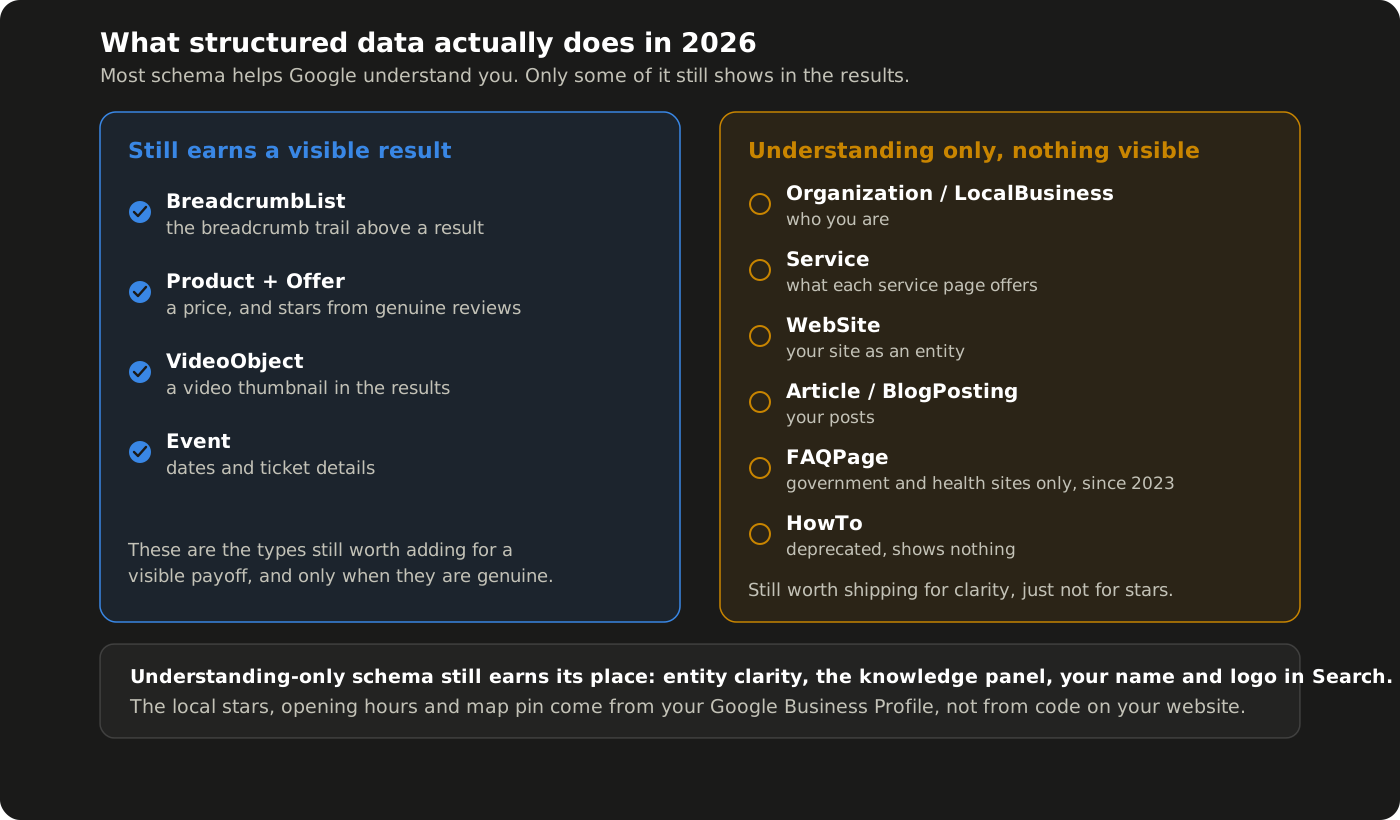
Only a handful of structured data types still earn a visible feature in the results for the kind of businesses we work with: BreadcrumbList (the breadcrumb trail), Product with Offer (a price, and review stars only when they come from genuine customers), VideoObject and Event. Those still show up.
Almost everything else is understanding-only. Organization and LocalBusiness, Service pages, WebSite, Article and BlogPosting all still matter, but they no longer produce anything you can see in the results. They ship for entity clarity, not for stars. A few types have been actively cut back: FAQ rich results have been restricted to government and health sites since 2023, so FAQ schema on an ordinary business site shows nothing; HowTo rich results were deprecated entirely; and the old WebSite search box was retired in 2024. None of these are worth adding for a visible payoff, because there is not one.
There is one more honest point that surprises people. The map pin, the opening hours and the review stars you see for local businesses come from the Google Business Profile, not from schema on your website. On-page structured data supports your local presence, but those visible local features are won in your Business Profile.
What we build into every site
Because we treat schema as understanding first and decoration second, we ship the same honest, useful set on every build, and we do it carefully.
Every site gets an Organization (or a truthful LocalBusiness where there is a real premises), a WebSite, a WebPage and a BreadcrumbList on every inside page, a Service on each service page, and a BlogPosting with a real author on each post. It is all built in one place, fed from a single record of the business's real details, so the name, address and phone number are written once and never retyped to drift out of sync. The whole thing renders through one component that safely escapes any special characters, so a stray symbol in a description can never break the page. And we validate every build on Google's Rich Results Test before it goes live.
The rule underneath all of it is honesty: the structured data must match what is actually on the page. We never mark up a review, a rating or a price that a visitor cannot see, because that is exactly what earns a penalty, and it is the single most common way schema goes from an asset to a liability.
The schema mistakes that cause real harm
Schema is safe and useful when it tells the truth, and risky when it does not.
Self-serving review stars. Putting an AggregateRating on your own business and rating yourself five stars used to sprinkle stars into the results. Google stopped rendering those self-serving stars, and self-applied ratings can trigger a manual penalty. Real review stars come from your customers and your Business Profile, not from marking up your own opinion of yourself.
Marking up things that are not on the page. Schema has to describe visible content. FAQ schema for questions that do not appear on the page, or a price the visitor never sees, breaks Google's guidelines and can be penalised.
Adding dead schema for show. FAQPage and HowTo markup added in the hope of rich results that no longer exist for ordinary sites. It is not harmful in itself, but it is effort spent on a payoff that is not coming.
Two competing business identities. A common technical fault where a site accidentally describes itself as two different organisations. Done properly, every page points at one business identity, so search engines see a single coherent entity rather than two half-formed ones.
Schema is an asset when it tells the truth about your page, and a liability the moment it does not. There is no clever exception to that.
Where to start
If you run a business site, the honest starting point is not "add as much schema as possible", it is "describe what you genuinely are, accurately". A correct Organization or LocalBusiness, a clean WebSite, breadcrumbs, and a Service type on each service page will do more for how search engines understand you than a pile of markup chasing rich results that will not appear. If you want the wider context, our guide to what SEO is explains where structured data fits alongside everything else.
Or let us handle it. Every site we build ships correct, validated structured data from the first commit, and we can audit an existing site's schema for the errors that quietly cost you, especially the self-serving markup that risks a penalty. We do this as part of our SEO work for UK businesses. Get in touch and we will tell you honestly what your structured data is doing, and what it is not.
Want this working for your business?
Tell us where you are now. We will come back with a clear picture of where you are losing ground online, and exactly how we would fix it.