7 September 2026
Why Are Ad Groups Important When Making a Google Ads Campaign?
Ad groups are the level where a Google Ads campaign controls relevance. Get them right and your ads match the search, your Quality Score rises and your clicks cost less. Here is why they matter.
Ad groups are important because they are the level of a Google Ads campaign where relevance is won or lost. An ad group is a small, themed bucket that holds a tightly related set of keywords together with the ads written to match them. When someone searches, Google shows an ad from the ad group whose keywords fit that search, so the closer the keywords, the ad and the landing page are to each other, the more relevant the whole thing looks to both Google and the person searching. Relevance is not a nicety here. It is what decides your Quality Score, and Quality Score decides how much each click costs and how often you show at all.
Put simply, ad groups are how you stop one generic advert being shown for every search. A roofing business that lumps "emergency roof repair", "new flat roof" and "chimney repointing" into a single ad group can only write one advert for all three, and that advert will be vague for every one of them. Split them into three ad groups and each search gets an advert that speaks to exactly what was typed. We are Seonat, a UK agency, and after three years running Google Ads for around twenty-five businesses, over half of them local trades, we can tell you that ad group structure is one of the biggest levers on what a campaign costs, and one of the most commonly botched.
An ad group is where a campaign controls relevance. Keep each one tightly themed and the ad matches the search; let it sprawl and every advert is vague for everything.
Where ad groups sit in a Google Ads campaign
Google Ads is built in layers, and ad groups are the middle one. If you are new to how paid search works, our guide to what PPC means covers the basics; this is the level underneath the campaign. Google's own documentation on how ad groups work describes an ad group as a set of ads and keywords built around a common theme.
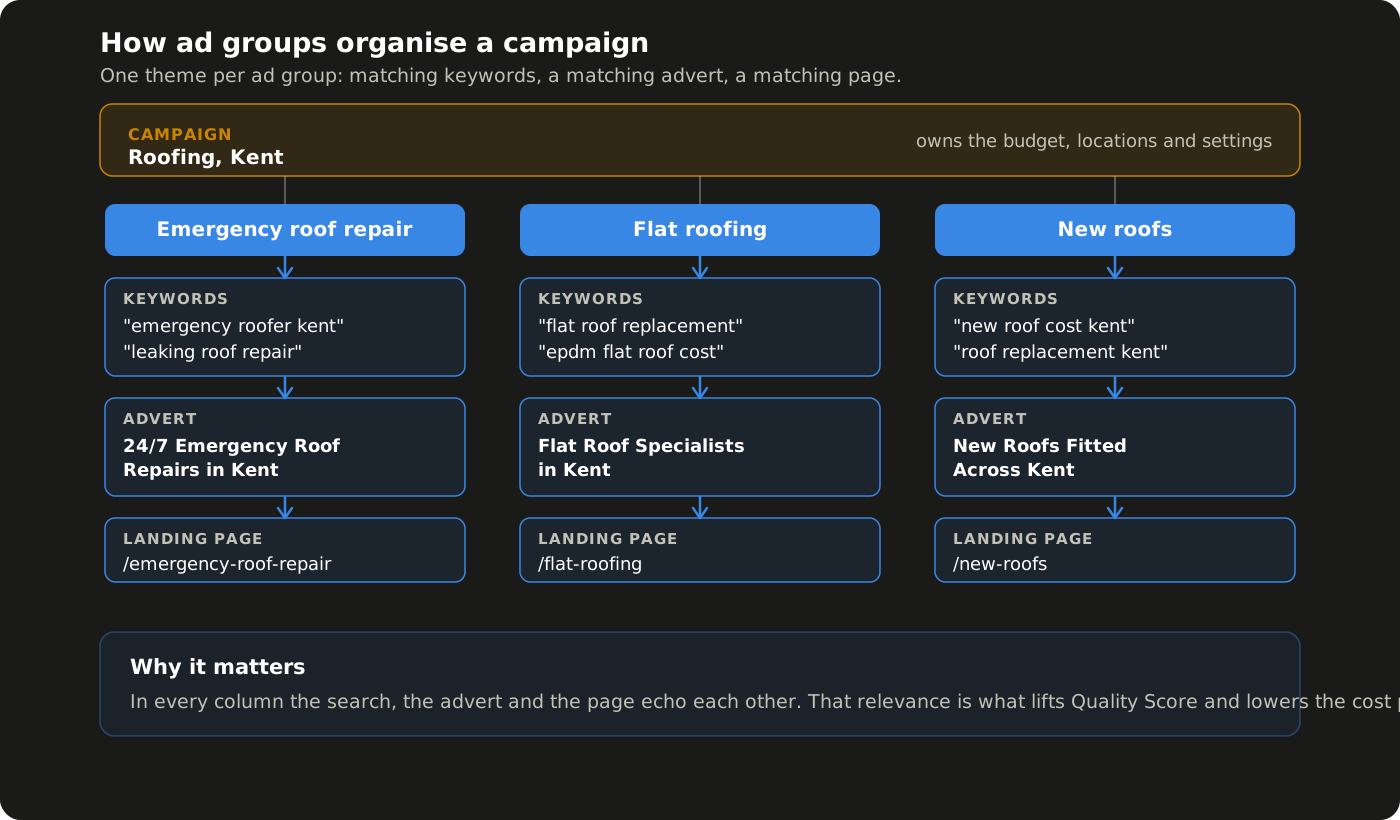
At the top is the campaign, which owns the budget, the locations you target and the big settings. Inside it sit your ad groups, each one a single theme. Inside each ad group are the keywords (the searches you want to appear for) and the ads that show when those keywords match. So the campaign sets the money and the rules, and the ad group is where you organise what you actually say, and to whom. One campaign might hold three or four ad groups, each a distinct service, each with its own keywords, its own ads, and ideally its own landing page.
Why ad groups decide your Quality Score
This is the part that costs or saves real money. Google gives every keyword a Quality Score, a rating out of ten built from three things: how likely people are to click your ad, how closely your ad matches the intent behind the search, and how relevant and useful your landing page is. A higher Quality Score earns you a better ad position for a lower cost per click. A poor one makes you pay more to appear in the same place, or keeps you out of the auction altogether.
Every one of those three ingredients improves when your ad groups are tightly themed. Keep a single search theme in one ad group and you can write an advert that repeats the searcher's own words, which lifts the expected click rate and the ad relevance, and you can send the click to a page about that exact service, which lifts the landing page experience. Sprawl three themes into one ad group and the same advert has to serve all three, so it matches none of them well, and all three scores suffer. From working with clients, we have found that fixing ad group structure often lowers cost per click before we have touched a single bid, purely because the relevance improved.
Message match: the right ad for the right search
Relevance is not only a Google metric, it is what persuades a human. Someone who searches "emergency roof repair" and sees an advert that says "24/7 Emergency Roof Repairs in Kent" feels understood; the same person shown a generic "Kent Roofing Services" advert is less sure you do the urgent thing they need right now. Ad groups are what make that match possible, because they let each themed advert answer a specific kind of search rather than gesturing at everything the business does.
That match should carry through to the page they land on. An advert about flat roofing should lead to a flat roofing page, not the homepage, so the visitor sees the thing they clicked for without hunting for it. Ad groups keep that chain honest: one theme, one advert, one page, all saying the same thing.
Structure gives you control and clear reporting
Ad groups are also how you understand what is working. Because spend, clicks and enquiries are all reported per ad group, a sensible structure turns the account into a readable set of themes: you can see that emergency work brings cheap enquiries while replacement quotes cost more, and move budget and bids accordingly. A single catch-all ad group hides all of that inside one blurry average, so you cannot tell the profitable searches from the wasteful ones. Good structure is what lets you spend less on the wrong clicks and more on the right ones, which is where most of the gains in an account actually come from. It is the first thing we look at when we take over the Google Ads management of an existing account, because a messy structure hides where the money goes.
How many ad groups, and how tight?
There is a real judgement here, and it has shifted. A few years ago the fashion was single-keyword ad groups, one keyword per group, chasing maximum control. In 2026, with broad match keywords and Smart Bidding doing more of the matching, Google steers advertisers towards fewer, broader ad groups so its automated bidding has enough data in each to learn from. That does not make ad groups less important, it changes where you draw the lines.
In our experience, a handful of tightly themed ad groups works better than either one catch-all ad group or dozens of single-keyword ones, because each theme is specific enough to earn a genuinely matching advert and page, yet broad enough to gather the conversion data that modern bidding needs to work. One home improvement account we run this way produced 3,103 tracked enquiries from just over £74,000 of spend, at £23 to £25 each, and disciplined ad group structure is part of why the cost per enquiry stayed that low. Tracking tells you what an enquiry costs; structure is a large part of why it costs what it does.
The ad group mistakes we see most often
When we take over accounts previously run by other agencies, the same faults appear again and again.
One giant ad group. Every keyword the business could think of, poured into a single group with one advert. It is the most common structure we inherit and the most expensive, because nothing is relevant to anything.
Themes that overlap. Two or three ad groups bidding on near-identical keywords, so they compete against each other in the auction and muddy the reporting. Each ad group should own its own distinct set of searches.
Ads that do not match the theme. An ad group called "flat roofing" running a generic company advert. If the advert does not echo the ad group's keywords, the structure is doing nothing.
Everything pointing at the homepage. Tidy ad groups undone at the last step by sending every click to the front page. The landing page is a third of Quality Score, so it has to match too.
The biggest wins usually come from spending less on the wrong clicks. Tight ad groups are how you tell the wrong clicks from the right ones in the first place.
Where to start
If you are building a campaign, start by listing the distinct things you want to be found for and make each one an ad group, then write an advert for each that repeats those words and point it at a matching page. If you already run Google Ads, open your ad groups and ask a blunt question of each: could I write one advert that genuinely suits every keyword in here? If the answer is no, the group is too broad, and it is costing you.
Or let us look at it with you. We manage PPC campaigns for UK businesses every day, and restructuring sprawling accounts into tight, relevant ad groups is one of the first things we do. Get in touch for a free review, and we will tell you straight where your structure is quietly costing you money.
Want this working for your business?
Tell us where you are now. We will come back with a clear picture of where you are losing ground online, and exactly how we would fix it.