19 October 2026
SEO vs AEO, What Is the Difference?
AEO is the new label for being quoted inside AI answers. Google says it needs no special work. Here is what really changes, and what does not.
SEO is the work of getting your website found in search results. AEO, which stands for answer engine optimisation, is the newer label for the same ambition pointed at a different surface, being read and quoted inside the answer an AI tool writes for somebody, whether that is ChatGPT, Gemini, Perplexity or Google's own AI Overviews. People expect the difference between the two to be technical and large. It is neither, and that matters if somebody is about to sell you an AEO package.
Google's own documentation is blunt about it. On the page explaining how sites appear in its AI features, Google says "There are no additional requirements to appear in AI Overviews or AI Mode, nor other special optimizations necessary", and adds that you do not need to create new machine readable files, AI text files or markup to appear in them. So the short answer is that AEO is not a separate discipline with its own levers. The work is almost all the same work. What genuinely changes is how you measure it, and what a visitor has already been told before they reach you. We are Seonat, a UK agency with three years of SEO experience as of July 2026, and the monthly reports we send clients now carry a page for AI search visibility, so this is not a theoretical question here.
Google says there are no additional requirements and no special optimisations for its AI features. Anything sold to you as a separate AEO technique has to be weighed against that sentence.
What SEO means
SEO, search engine optimisation, is everything that makes a website easy for a search engine to find, understand and trust, so it appears when somebody searches for what you sell. It covers the technical foundations, the words on your pages, your local presence and the links other sites give you. Our plain English guide to what SEO is walks through the parts in order.
The measure of it is simple. More of the right people arrive from search, and enough of them get in touch to make the work pay.
What AEO means, and where it came from
AEO describes writing and structuring pages so an answer engine can lift a clear answer out of them and credit you. The term grew up alongside AI Overviews, AI Mode and the AI assistants, and a related label, GEO or generative engine optimisation, means much the same thing.
The idea behind it is reasonable. A tool that writes an answer needs a source it can quote, and a page that answers a question plainly in its first lines is easier to quote than one that takes six paragraphs to get going. Nobody should argue with that. The argument is about whether it is new, and what it costs you.
What Google says you have to do differently
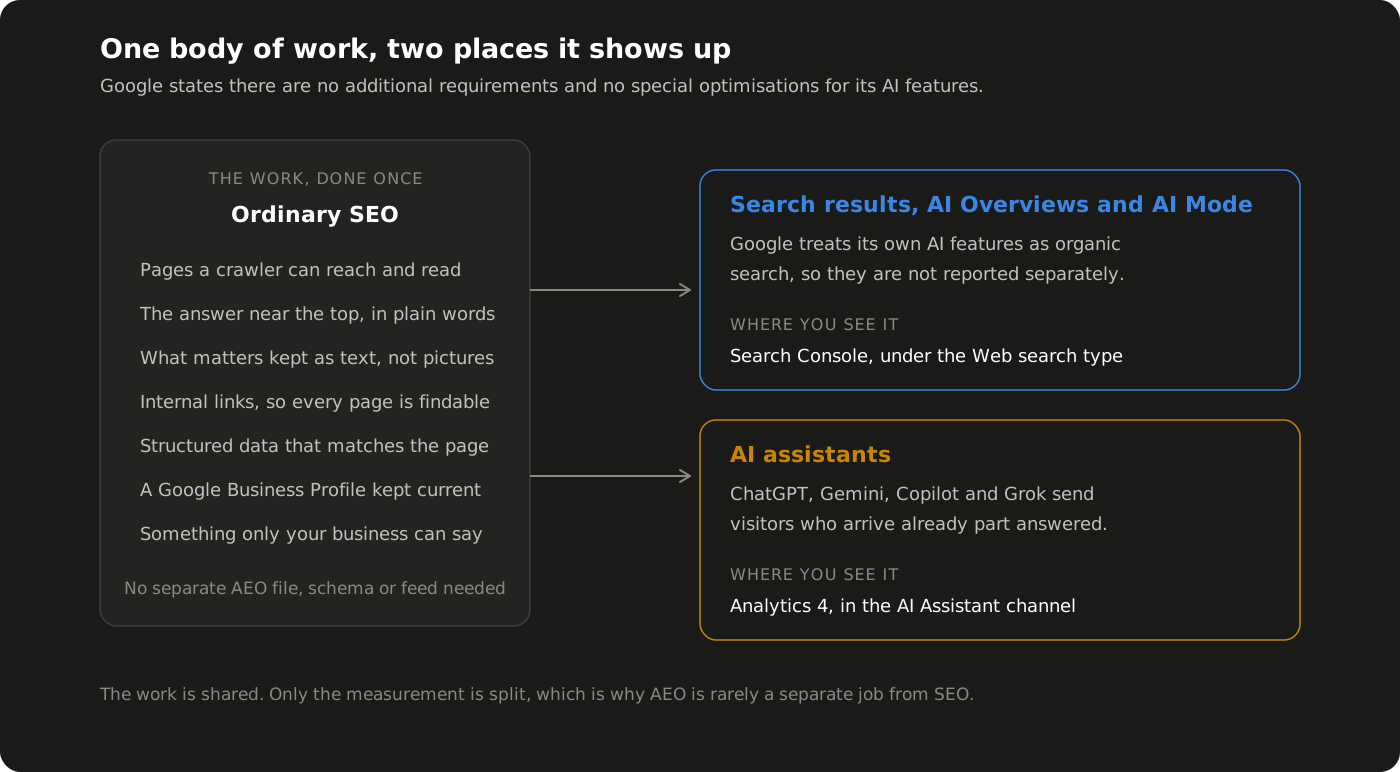
Nothing, in technical terms. Google's guidance on its AI features sets one bar for eligibility, that the page is indexed and allowed to show a snippet, then says there are no additional technical requirements. Its list of what helps is the ordinary list. Let crawlers in, link your pages together so they can be found, give people a good page experience, keep important content as text rather than locked inside images, make sure any structured data matches what a visitor can actually see, keep your Google Business Profile accurate and verify the site in Search Console.
Two points in that guidance are worth saying out loud, because they are the two things most often sold as AEO work. There is no special schema you need to add for AI features. And you do not need an llms.txt file or any other new machine readable file. Structured data is still worth having, for the reasons we set out in our guide to schema in SEO, but it is not an entry ticket to AI answers.
What genuinely changes, and most of it is measurement
Here is the part that is real, and it is the part most AEO articles skip.
Where AI traffic shows up is split in two. Google counts AI Overviews and AI Mode as organic search, so they sit inside your normal Search Console figures under the Web search type and you cannot separate them out. Visits from the assistants are different. Google Analytics 4 now has its own AI Assistant channel for arrivals from tools like ChatGPT, Gemini, Copilot and Grok, and it deliberately excludes AI Overviews and AI Mode, which stay under organic search.
The numbers are small, and they are starting. In September 2026, one of our clients, a windows and doors company, recorded its first visits from ChatGPT, eight of them in the month, sitting in that AI Assistant channel. For another client we also track how often the business is named in AI answers, and in a single month that came to seven brand mentions and 147 cited pages across ChatGPT, Google AI Overviews, AI Mode and Gemini. Those are real numbers from real accounts, and they are the honest scale of it today for a small UK business. They are worth watching. They are not yet worth rebuilding a website around.
The visitor arrives knowing more. Somebody who has read an answer before clicking has already had the basics explained. They tend to arrive with a narrower question, which makes the page they land on, and the ease of contacting you, matter more than ever.
What actually helps
Strip the labels away and the list of useful work barely moves.
Answer the question early. Put the direct answer in the first couple of paragraphs, then explain it properly underneath. This is good writing for a reader, and it happens to be what makes a passage quotable.
Keep the answer in text. A point made only inside an image, a video or a script that runs after the page loads is a point a machine may never read.
Write what only you can write. Prices you actually charge, the way you really work, the jobs you have done. Anything assembled from what is already online is exactly what an AI tool can generate for itself, so it has no reason to cite it.
Get the foundations right. Fast, crawlable, well linked, with headings that say what each section covers. The same list that has carried search for years.
Look after your Google Business Profile. For a local business the profile still decides the map pack, and Google's own AI guidance tells you to keep it current.
The practical difference between SEO and AEO is one of emphasis, not of technique. Answer plainly, in text, with something only your business can say.
What to watch when somebody sells you AEO
Be careful with the evidence. Published results for AEO are thin on the ground, and the impressive numbers in most pitches are the seller's own, measured by the seller, with no way for you to check them. That is reason enough to ask hard questions, and the questions are the same ones we would ask of any SEO company you are reviewing.
Ask what the work actually is. If the answer is clearer pages, better internal linking, accurate structured data and content worth quoting, that is good work, and it is work your existing SEO should already cover. If the answer involves a new file for the AI crawlers, a bundle of FAQ markup or a monthly fee to be "indexed by ChatGPT", check it against the paragraph of Google guidance above before you pay for it.
Ask how it will be measured, too. A seller who cannot tell you where the number will come from, in your own Analytics or Search Console, is selling something you will never be able to audit. We would also rather you knew the limits. Nobody controls what an AI tool decides to quote, and anyone promising you a fixed place inside an answer is promising something they cannot deliver.
Where to start
If you are doing SEO properly, you are already most of the way to AEO. Make sure each page answers its question in the opening lines, keep what matters in readable text, keep your structured data honest and watch the AI Assistant channel in Analytics so you know when the numbers start to move for you rather than in somebody's case study.
If you want a straight answer about where your site stands, our SEO work starts with what your own data already shows, and we will tell you plainly if the answer is that your foundations need fixing first. Get in touch with the team at Seonat and we will go through it with you.
Want this working for your business?
Tell us where you are now. We will come back with a clear picture of where you are losing ground online, and exactly how we would fix it.