2 November 2026
What Is TL;DR, and Why Does It Matter for SEO?
TL;DR means too long, didn't read. The habit behind it, answering early in plain words, is worth more to your website than the label ever will be.
TL;DR stands for "too long, didn't read". It began as a complaint, posted under a wall of text by somebody who could not face reading it, and it turned into something more useful. Today a TL;DR is the short summary at the top of a long piece that gives you the answer in a line or two, so you can decide whether the rest is worth your time.
It matters for SEO, but not in the way it is usually sold. Writing the letters TL;DR on a page is not a ranking technique, there is no markup for it, and Google will not reward you for the label. What matters is the habit underneath it, which is answering the question early, in plain words, near the top of the page. That habit helps the people who find you, it gives search engines and AI tools something clean to quote, and it is the single easiest improvement most business websites could make this month. We are Seonat, a UK agency, and our own writing rules say every post has to answer what somebody searched for inside its first two paragraphs, which is this idea applied to ourselves.
The letters are not the point. Answering the question early, in plain language, is the point.
What people actually do with your page
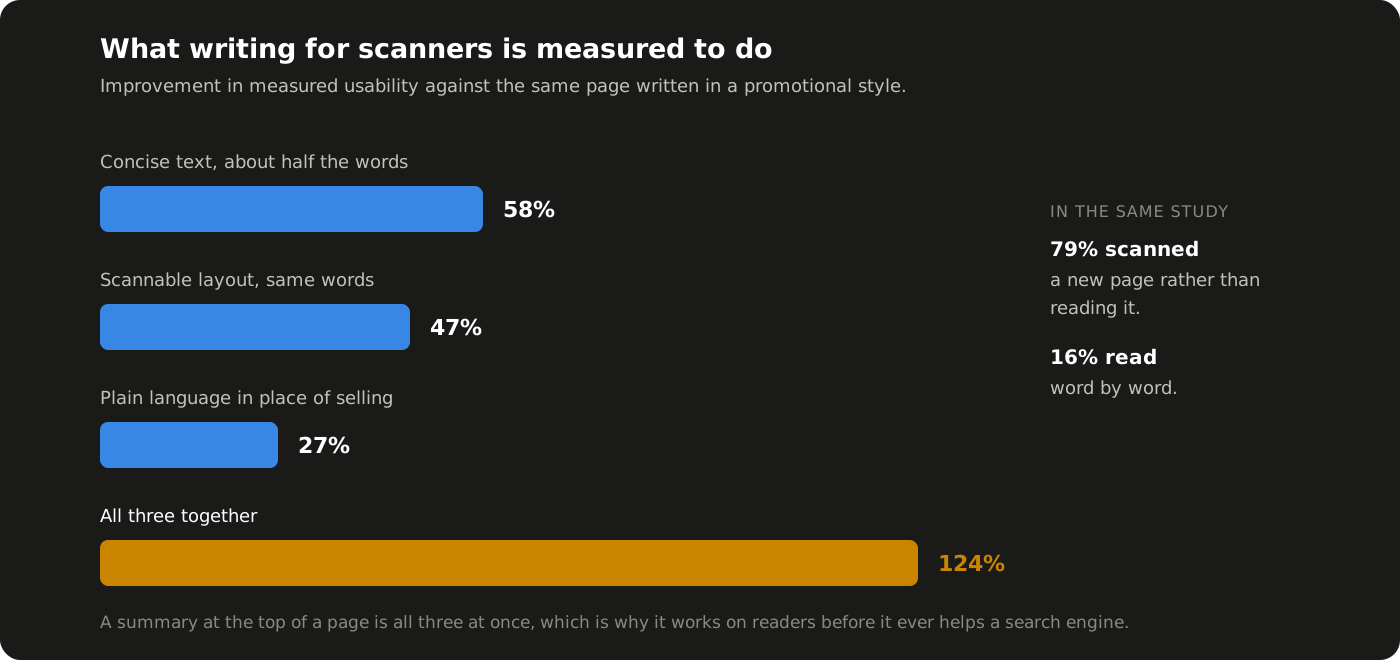
Almost nobody reads a web page the way they read a book. Nielsen Norman Group's long-running work on reading behaviour found that 79% of the people they tested scanned any new page, while only 16% read it word by word. People hunt for the bit that answers them and skip everything else.
The same research into how users read on the web measured what happens when you write for that behaviour instead of against it. Cutting the word count roughly in half improved measured usability by 58%. Laying the same text out so it could be scanned improved it by 47%. Dropping promotional language for plain, factual wording improved it by 27%. Doing all three together improved it by 124%.
Those numbers describe exactly what a good summary at the top of a page does. It is concise, it is scannable, and it tends to be written plainly, because there is no room for anything else.
What a summary does for search
Here is where the honesty has to come in, because a lot of advice overstates this.
A clear, early answer makes a page eligible for the kinds of placement that need one. Featured snippets are the obvious example, and Google is clear about how they work. Its systems decide whether a page would make a good snippet for somebody's search and then lift it to the top of the results, and when site owners ask how to mark a page up so it becomes one, Google's own documentation answers in two words. You can't. There is no tag, no schema and no request form. What you can do is make sure the answer exists on the page, in text, in a form that stands on its own.
The same applies to AI answers. A tool writing a reply needs a passage it can lift and credit, and a page that spends six paragraphs warming up gives it nothing to work with. That is the whole of the overlap between this and the AEO work being sold at the moment, which we went through in SEO vs AEO.
There is a second effect, and it is the one that shows up in your figures. Somebody who lands on a page and finds the answer in the first few lines has a reason to keep reading and a reason to trust you. Somebody who has to dig for it goes back to the results and tries the next site. Search engines have no shortage of ways to notice that pattern, and in any case the enquiries are what you are after, not the ranking.
Google will not let you request a featured snippet. All you can do is make sure the answer is on the page, in text, and easy to lift.
How to write one that earns its place
Start with the question the page exists to answer, and answer it in the first two sentences, before any throat clearing about your 20 years in the industry. Then explain it properly underneath, because the summary is a doorway rather than a replacement.
Write it in plain words, not marketing ones. A summary that says "we deliver bespoke solutions tailored to your needs" has answered nothing, and the research above says the promotional version measures worse than the plain one.
Keep it honest about what follows. The summary is a promise about the rest of the page in the same way a button label is a promise about the next page, and a summary that oversells what is underneath annoys the reader twice.
Put the detail below it, not elsewhere. A summary with nothing substantial under it is a thin page with a nice opening, and thin pages are the thing Google's quality work has been removing for years.
As for the label itself, be careful. On a professional services site the letters TL;DR read as internet slang, and an opening paragraph that simply gives the answer does the same job without the costume. Use the words In short, or The short answer, or just write the answer. The technique is what matters, not the branding of it.
It is not only for blog posts
Most advice about this treats it as a writing trick for long articles, which undersells it. The pages that gain most on a business website are the ones where somebody is deciding whether to contact you.
A service page can say what the service is, roughly what it costs and who it suits, before the gallery and the history. A pricing page can lead with the range rather than making people request it. A location page can say which areas are genuinely covered in the first line, which saves the enquiries you were never going to be able to serve. Even a contact page benefits, because saying how quickly you reply, and what happens after somebody sends the form, removes the main reason people hesitate.
None of that costs you the detail. It just stops the detail standing between the reader and their answer.
Where it goes wrong
The common failure is summarising something you never say. If the answer in the first paragraph is not supported by anything underneath, you have written a headline rather than a page, and the visitor who came for the detail leaves disappointed.
The second failure is repetition. A summary, then an introduction that repeats the summary, then a section that repeats the introduction, is how a 600 word answer becomes a 1,500 word page that says less. Say it once, properly, and let the rest of the page add to it.
The third is hiding the answer inside an image, a video or a slider. Google and every AI tool read text. A point made only in a picture is a point that the machine reading your site never sees, and a visitor who is scanning will probably miss it too.
Where to start
Open your most important page and read the first two sentences as though you were a stranger in a hurry. If they do not tell you what the business does, who it is for and what to do next, you have found this month's job. The rest of the page probably does not need rewriting, it just needs its answer brought to the top.
If you want somebody to go through your pages and tell you honestly which ones bury their answer, that is part of our SEO work, and it starts with the pages you already have rather than a plan to write 40 new ones. Our guide to what SEO is sets out where this sits alongside everything else. Get in touch with the team at Seonat and we will tell you what your pages answer, and how quickly.
Want this working for your business?
Tell us where you are now. We will come back with a clear picture of where you are losing ground online, and exactly how we would fix it.