28 September 2026
What Is Vercel?
Vercel is the hosting and deployment platform from the company behind Next.js. Here is what it does, what it costs a business, and how we use it to run client websites.
Vercel is a hosting and deployment platform for websites and web apps, made by the company that created the open-source Next.js framework. Your developer writes the site as code and keeps it in a Git repository, and Vercel turns each saved change into a working website: it builds the pages, serves them from a worldwide network, sets up the security certificate and gives every change its own preview link before it goes live.
For a business owner, that means there is no dashboard where you log in and change a page, because changes are made in the code, normally by whoever built the site. The free plan is not for you either, because Vercel reserves it for personal, non-commercial use, so whoever hosts your site needs the Pro plan, from $20 a month plus VAT, with usage on top beyond what is included. And the hosting itself is managed, with no server to set up or patch. We are Seonat, a UK agency. We moved our own website from WordPress to Next.js on Vercel in early July 2026, and at the time of writing 16 of the 25 sites in our portfolio run on it.
Vercel is where a coded website lives. It builds the site from your developer's code, previews every change and serves it worldwide, but it is not somewhere you log in to edit pages.
Who makes Vercel, and how it relates to Next.js
Vercel was founded by Guillermo Rauch, who set the company up as ZEIT in 2015, launched its first product the following year and renamed it Vercel in April 2020. In October 2016 the same team released Next.js as open-source software, and the Next.js website still introduces it as "Next.js by Vercel".
The two names get used interchangeably, but Next.js is the framework your developer writes the site in, and Vercel is the platform that builds and serves it. Next.js does not need Vercel: its own documentation says it can run on an ordinary Node.js server or in a Docker container. Vercel is not limited to Next.js either, and lists dozens of other frameworks it can deploy, from Astro to SvelteKit. We use the two together because Vercel runs Next.js natively. For our own site we had planned on Cloudflare Pages, and switched to Vercel the same day for exactly that reason.
How a change goes from code to your live site
The site's code sits in a Git repository, usually on GitHub, which records every change ever made. Vercel is linked to that repository. When a developer pushes a change on a separate branch, Vercel builds that version of the site and gives it its own preview address, so the people checking it can click through the real site with the change in it. By default, Vercel asks anyone opening a preview to log in first. When the change is approved and merged into the main branch, Vercel builds the production version and puts it live on your domain.
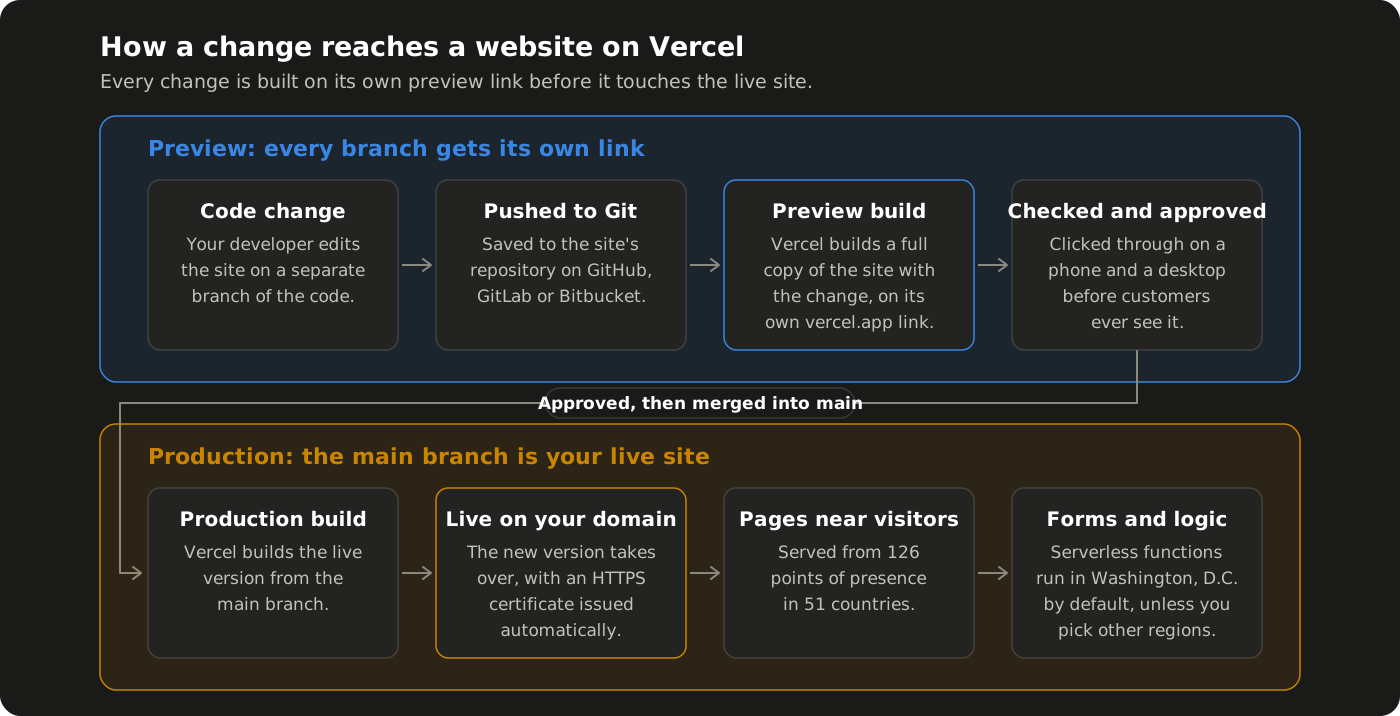
Once live, the pages are served from Vercel's network, which its documentation puts at 126 points of presence in 51 countries, so visitors get the page from somewhere near them. The parts that have to think, such as a form handler, run as serverless functions: small pieces of code that start when needed and are billed mainly for the time they spend working. They run in Washington, D.C. by default; Pro teams can pick up to five regions, including London and Dublin, which is worth checking if your data sits in the UK.
Vercel also issues and renews the security certificate for every domain, protects every deployment against DDoS attacks at no extra cost, and gives each project a free .vercel.app address to use before the real domain points at it.
What Vercel is not
It is not a website builder. Its templates are starter code for developers, and there is no admin area for editing pages. If you want to edit content yourself, a separate content management system has to be connected and the site built around it. On the sites we build on Vercel, clients do not edit pages at all: they send us the change and we make it.
It is not an email host. Vercel does not host mailboxes, and if a developer moves your domain's nameservers to Vercel, your existing email records are replaced and have to be added back. In our experience, leaving the nameservers where they are and adding Vercel's records works better than moving the nameservers to Vercel, because your email records stay exactly as they are, so launching a website is much less likely to take your inbox down with it. When we move a site, that usually means changing one or two records.
It is not a WordPress host. Vercel has no official PHP runtime, and WordPress also expects a MySQL database and permanent disk storage, which Vercel's functions do not provide. Where the two meet, WordPress normally runs elsewhere and Vercel serves a separate front end. Our guide to the different website platforms compares the options side by side.
What Vercel costs a business
Vercel prices in US dollars and excludes VAT, so a UK bill moves with the exchange rate. At the time of writing (September 2026):
Hobby is free, and it is not for business. Vercel's fair use guidelines restrict it to non-commercial personal use. Their examples of commercial use include advertising the sale of a product or service, and receiving payment to create, update or host the site. That second example catches every site an agency or freelancer was paid to build.
Pro costs $20 a month. That includes one deploying seat and $20 of usage credit each month; extra deploying seats are $20 each. Since 8 September 2026, new Pro teams get flat-rate delivery covering 1 million requests and 1 TB of data transfer a month, with traffic spikes above that served without being billed, within fair use. If a whole month's traffic goes over, Vercel moves the team up a tier from the following month, starting at an extra $20 a month for 10 million requests. Other usage beyond the credit, such as function time, is billed on top. New teams get a default budget of $200 with alerts as it is used, but reaching it stops nothing unless you switch on the option to pause production deployments.
If a developer or agency hosts your site on Vercel, ask which plan it is on and who receives the usage alerts.
Where it is strong, and where it falls short
Every change can be checked on its own link before customers see it. Pages can be very fast: on one recent like-for-like rebuild of a page-builder WordPress site, we measured the largest element on the page appearing in 792 milliseconds against 4,424 on the original. Not all of that is Vercel: the rebuild also dropped the page builder, which a WordPress site can do too. And the code is not trapped. It sits in a Git repository rather than inside Vercel, and Next.js 16.2 added a stable, public way for other hosts to run it, though Cloudflare's and Netlify's adapters were still being built at the time of writing. Vercel-only features such as scheduled jobs would need replacing on a move.
The weaknesses are just as real:
- You need a developer for every change. That is the trade for having no editor to break.
- Usage billing can surprise people. In June 2024 an app called Cara was sent a $96,280 Vercel bill for one week of serverless functions after a surge in users, as TechCrunch reported. Optional spending caps already existed; default budget alerts came later, and flat-rate delivery would not have helped, because function time is still metered.
- Serverless functions have limits. On a members' web app we took over, uploads hit a 4.5 MB limit on each request, and chat checks for new messages at intervals rather than holding a connection open, which Vercel supports only in beta. We designed around both.
- It depends on Amazon's cloud. Vercel runs on AWS, and an AWS outage on 20 October 2025 caused a partial Vercel outage.
How we use Vercel day to day
We rebuilt our own site in two days, and the old WordPress site stayed live until the domain switched over. We moved for control as much as speed, and every site added to our portfolio since the start of August 2026 runs on the same Next.js and Vercel stack.
Vercel keeps preview links out of search engines, but the live version also answers on its own .vercel.app address, which search engines can crawl. On several of our builds only the real domain can be indexed or send data to tracking, which keeps test visits out of a client's analytics. That has a trap: on one build the switch was read when the site was built, and attaching a domain does not trigger a new build, so without a fresh build on launch day the site would have gone live telling Google not to index a single page. Changed settings behave the same way, and only reach the site after a fresh build.
Blog posts go live on their date with no content management system and nobody at a laptop: this post was written days before 28 September, and the date in its file is what published it. We have found one wrinkle here. On 10 August 2026, three of our client sites were serving sitemaps that were meant to refresh hourly but had not changed for roughly three days on two of them and nearly six on the third, so a new post could go live without being listed. On those sites the fix was to build the sitemap fresh on every request, and we now check the live file's age rather than assume it updated.
On one shop build, a setting that adds a slash to the end of every address also redirected Stripe's payment notifications, and Stripe does not follow redirects, so a customer would have been charged while the site's own order notification never reached the business. We caught it before launch. Framework updates need the same care: on one site a point release changed how its blog addresses were routed, so there we compare the full list of pages before and after every upgrade.
A coded site is not a finished object. It needs someone who knows where the traps are, and who checks the live site rather than trusting the build.
Who Vercel suits, and who it does not
Vercel suits a business that wants a fast site and is happy for a developer to make the changes. It suits one less well if the team wants to edit pages every week without help, or wants one host for email and WordPress too. From working with clients, we have found the question that settles it is not technical at all: who will make the changes, and how often?
If you are planning a rebuild, we can talk through whether Vercel fits as part of a website design project. Get in touch and we will go through it with you.
Want this working for your business?
Tell us where you are now. We will come back with a clear picture of where you are losing ground online, and exactly how we would fix it.