9 November 2026
What Is Lovable, and Is It Any Good for a Business Website?
Lovable builds websites and apps from a conversation. Here is what it genuinely does well, what it costs in pounds, and what to check before you trust it.
Lovable is an AI tool that builds websites and web apps from a conversation. You describe what you want in plain English, it writes the code, hosts the result and puts it online, and in its own words it is "an AI software engineer, which enables anyone to build for the web", with no technical knowledge needed. Ask it for a booking page for a dog groomer and a few minutes later there is a working booking page, on a real address, that you can share.
For a business owner the question is not whether that is clever, because it plainly is. The question is whether the thing it produces is good enough to be the website your customers find on Google and judge you by. Our honest answer is that Lovable is a genuinely useful tool for prototypes, internal tools and testing an idea quickly, and that using it for a company's main website is a decision with specific trade-offs around search, security and who maintains it afterwards. We are Seonat, a UK agency, and we build client sites in code rather than with an AI builder, so take this as the view of people who do the work the tool is automating, with the sources quoted so you can check us.
Lovable is very good at getting something working. A business website is mostly the part that comes after something is working.
What you actually get
Lovable produces a real application rather than a page in a page builder. It writes the code, keeps it in a project you can edit by chatting, and publishes it to a free address ending in lovable.app. Hosting is included on every plan, and the live site is a snapshot, so edits appear for visitors only when you press publish.
Two points matter more than the demos suggest. The code behind the app is yours, which is better than most website builders can say, because your work is not locked inside somebody's template system. And the free plan does not carry your own domain name, so a business will be on a paid plan from the start.
What it costs
Lovable's pricing page sets out the plans in pounds. Free costs nothing and includes a small daily grant of build credits, which do not roll over, plus up to five lovable.app addresses. Pro is £22 a month with 100 credits, and it is the first plan that allows a custom domain and removes the Lovable badge from your site. Business is £44 a month, adding team controls, single sign on and a security centre. Enterprise is priced on request.
The part people underestimate is the credit model. You are not buying seats or pages, you are buying messages, and a message costs more credits the more complicated the request is. That is fine when the build is going well. It is less comfortable when something is broken and each attempt to fix it spends credits, because the bill grows at exactly the moment you are getting least value. Budget for the building, not just the subscription.
Where it is genuinely good
Speed, and the removal of a blank page. For an internal tool, a prototype to put in front of a few people, or a rough version of an idea you want to test before paying anyone to build it properly, Lovable does in an afternoon what used to take a fortnight of back and forth. A small business wanting a single page that explains one service and takes enquiries could get a long way with it.
It is also an excellent way to find out what you actually want. Plenty of projects stall because nobody can picture the thing being discussed, and a working version, however rough, ends that argument quickly.
Where it gets harder for a public website
Search engines have to be able to read it. This is the most common criticism of AI builders, and it is the one that has moved most recently, so it is worth being accurate. Older Lovable projects were built on React with Vite, where the browser assembles the page using JavaScript, so a crawler initially receives what Lovable's own documentation calls "a mostly empty page", with pre-rendering used to serve something readable. Newer projects use a different foundation that renders each page into finished HTML on the server before sending it. Lovable's documentation says that became the default for new projects on 13 May 2026, and for new Enterprise projects a month later. So the fair summary is that a project started today is in much better shape than one started last year, and an older project should be checked rather than assumed.
Rendering is not the whole of search. A page a crawler can read still needs a unique title and description, headings in a sensible order, a sitemap, internal links and honest structured data, which we cover in our guide to schema in SEO. None of that arrives by default from a prompt, and the usual symptom is a site where every page shares one title.
Security sits with you. In May 2025 a vulnerability was published for Lovable, CVE-2025-48757, scored 9.3 out of 10 and described as an insufficient database security policy that allowed unauthenticated attackers to read or write arbitrary database tables of generated sites. It is marked as disputed by the supplier, on the grounds that each customer accepts responsibility for protecting their own application's data, and Lovable's own security documentation says the same thing in gentler words. It notes that misconfigured access rules are a common cause of data leaks, that its automatic scan runs a fixed set of checks in seconds, and that "You are responsible for ensuring that your app meets the security requirements appropriate for its use case". That is a reasonable position for a tool to take. It is a heavy one for a business owner who does not know what a row level security policy is, and it matters the moment the app holds customer details.
The unglamorous parts are still yours. A cookie consent banner before any tracking loads, a privacy policy, labelled form fields that a screen reader can use, conversion tracking that proves the enquiries arrived, redirects from every old address when you replace a site, image sizes that do not punish a phone on a weak signal. Nobody prompts for these, so they tend to be missing, and each one is either a legal exposure or a quiet loss of enquiries.
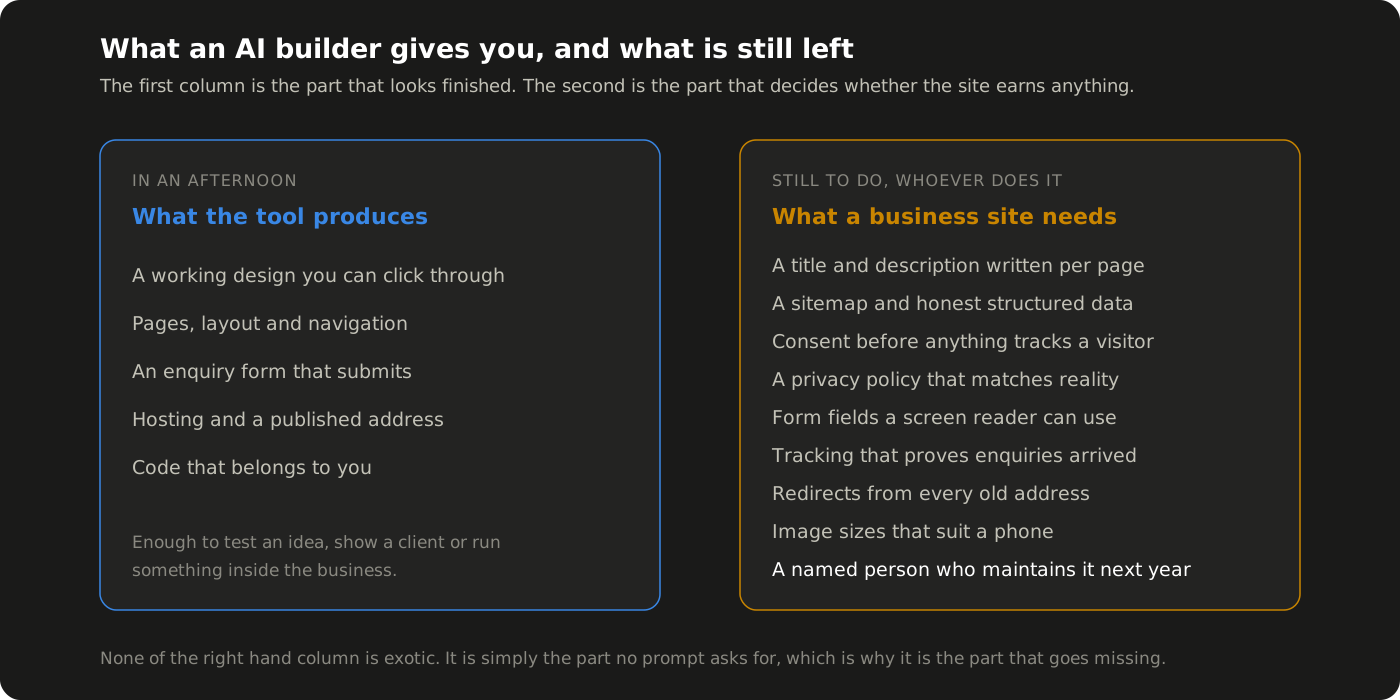
Somebody has to own it next year. The tool writes the code, but it does not take responsibility for it. When something breaks after a dependency update, or an enquiry stops arriving, the question is who understands the thing well enough to fix it. If the answer is nobody, you have a website nobody can safely change, which is the same trap as an abandoned page builder site with a different badge on it.
The code is yours, and so is the responsibility. That is the honest trade with any AI builder.
How it compares with the usual options
If you want the fuller comparison, our guide to the different website platforms covers WordPress, the drag and drop builders, e-commerce platforms and code. In short, Lovable sits closest to the code end while removing the need to write it, which is why it shares the strengths of a coded site, speed and flexibility, and its weakness, that changing it is a technical job rather than an editing job.
We build client sites in Next.js and host them on Vercel, which is the approach we set out in what Vercel is. The reason is not that AI is not involved, because it is, every day. It is that a business site has to survive contact with Google, a solicitor's view of your privacy policy and three years of changes, and we would rather own every line of that than discover its shape when something breaks.
Where to start
If you want to test an idea, prove a concept or build something internal, try it. The free plan is enough to find out whether the idea works, and you will learn more in a weekend than in a month of meetings.
If it is the website your customers will find, judge it on the same list as any other build. Can search engines read every page, does every page have its own title and description, where does the enquiry go, what happens to your old addresses, is there a consent banner before anything tracks a visitor, and who fixes it in eighteen months. If you want a straight opinion on whether what you have built is ready to be your main site, we will give you one as part of a website design conversation, including when the answer is that it is fine as it is. Get in touch with the team at Seonat.
Want this working for your business?
Tell us where you are now. We will come back with a clear picture of where you are losing ground online, and exactly how we would fix it.