10 August 2026
Why Is Conversion Tracking on Google Ads Important?
Conversion tracking is what tells Google Ads which clicks became real enquiries, not just visits. Here is why it is the foundation of every profitable campaign, and the tracking mistakes we find most often.
Conversion tracking matters because it is the only thing that tells you whether your Google Ads budget is producing customers or just clicks. It is a small piece of code that records what happens after someone clicks your ad: whether they filled in your contact form, rang your number or booked a job, or whether they simply looked and left. Turn it off and Google can still report how many people clicked and what each click cost, but not which of those clicks became enquiries. For a business owner, that is the difference between knowing your advertising works and hoping it does.
There is a second reason, and it is bigger: modern Google Ads cannot be run properly without it. Google's automated bidding, which now sets almost every bid in almost every account, learns from conversion data. Feed it clean information about which clicks turn into enquiries and it chases more of those people; feed it nothing and it falls back to buying the cheapest clicks it can find, customers or not. We are Seonat, a UK agency. After three years running Google Ads for around twenty-five businesses, over half of them local trades, we can tell you that conversion tracking is the first thing we fix on any account we take over, before we touch a single bid.
Get conversion tracking right and every other decision in the account has something true to stand on. Get it wrong and everything built on top of it is wrong too.
What conversion tracking actually is
Conversion tracking on Google Ads is built on two bits of code. The first is the Google tag, a single snippet on every page of your site. The second is an event snippet (or a phone snippet for calls) on the specific action you care about, telling the Google tag the moment a conversion happens. The tag sets a first-party cookie on your own domain that remembers the ad click that brought each visitor in, so when they later enquire, Google can tie the enquiry back to the click and the keyword that earned it.
If you are new to how paid search works, our guide to what PPC means covers the basics; this piece is the measurement layer underneath it. What counts as a conversion is up to you: in Google Ads these are called conversion actions, and for the service businesses we work with they are almost always two, a completed contact form and a phone call. Google's own conversion tracking documentation sorts them into website actions, phone calls and offline conversions, but the principle is the same: you mark the activity that is worth money to you, so the platform can count it and learn from it. Calls can be tracked straight from an ad, or to a website number by swapping in a forwarding number, with a minimum call length so a real conversation counts and a hang-up does not.
Why conversion tracking is the foundation
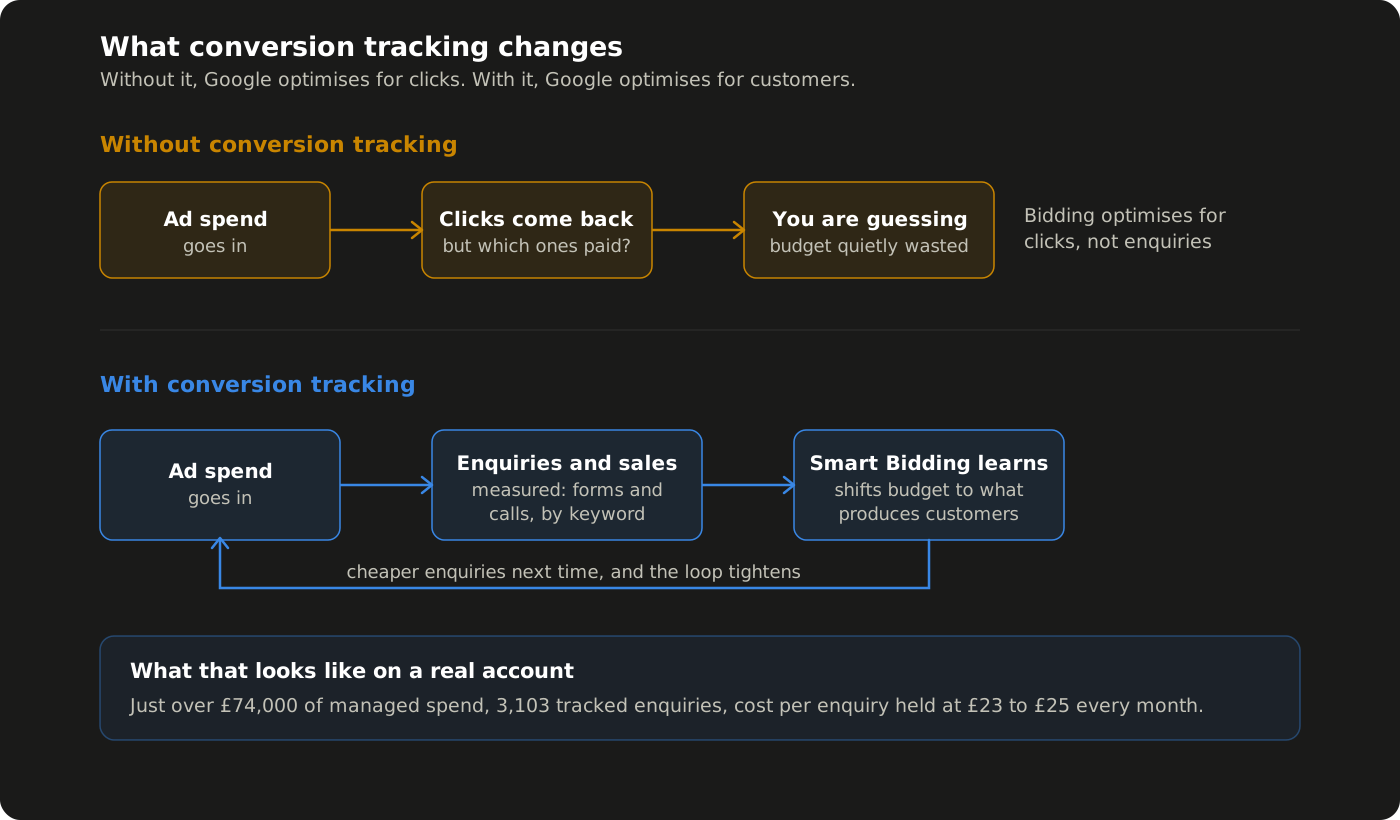
On Google Ads, measurement is not advice, it is a technical requirement: Google states plainly that to use Smart Bidding you need conversion tracking enabled. Smart Bidding is not an optional extra in 2026, it is how Search, Performance Max and Shopping campaigns run by default, and every strategy (Maximise conversions, Target CPA, Target ROAS) optimises towards conversions or their value. Take the conversion feed away and only one honest goal is left to chase: clicks.
That distinction is the whole game. Clicks prove people noticed your ad and visited; conversions prove whether those visits became calls, enquiries or sales. Optimising to clicks buys traffic and browsers, optimising to conversions buys customers, and an account with no tracking is forced into the first mode whatever you spend. Data quality matters as much as presence: the bidding trains on your conversion signal, so a wrong signal gives wrong predictions, and poor tracking steers budget the wrong way while looking like it works.
How conversion tracking kills wasted spend
Once every enquiry is tracked, the account stops being a mystery. If you do not know which keywords produce phone calls and enquiries, you are not managing an account, you are guessing, and the guessing is expensive. When we audit accounts previously run by other agencies, we repeatedly find broken or missing tracking, and underneath it the same pattern: a large share of the budget going to searches that never produced a single enquiry, invisible because nobody was counting.
Good tracking makes that waste visible, and once you can see it you can cut it. It gives you a real cost per enquiry for every keyword, so you can move money off the ones that drain the budget and onto the ones that fill the diary. What clients feel is not a bigger budget, it is a cheaper customer.
The proof is in numbers we can stand behind. One of our clients invested just over £74,000 in Google Ads across four months and received 3,103 tracked enquiries, counted through forms and phone calls, at a cost per enquiry of £23 to £25, for jobs typically worth £1,000 to £10,000 each. None of that reporting exists without conversion tracking; the 3,103 is the tracking. Without it, all we could have told that client is that a lot of people clicked.
The biggest wins in a Google Ads account come from spending less on the wrong clicks, not from spending more overall. You can only find the wrong clicks if you are counting the right ones.
Enhanced Conversions, offline sales and privacy in 2026
For phone-and-lead businesses, the click is only the start. Someone rings on Monday, you quote on Wednesday, the job is booked a fortnight later. Google sees the call but not whether it became a paying customer, unless you tell it. Two tools close that gap.
The first is Enhanced Conversions, which supplements the standard tag by sending Google hashed first-party data from your own forms, an email or phone number scrambled with SHA-256 so the raw details never reach Google in readable form. Google matches it against people signed in to a Google account when they engaged with your ad, recovering conversions the cookie-based tag would otherwise miss.
The second is offline conversion import. When a lead closes in your office or over the phone rather than on the website, you upload that sale back to Google Ads against the original click, so bidding learns to chase leads that become jobs, not leads that are merely cheap. Enhanced Conversions for Leads now does this by matching on hashed form data rather than a stored click ID, and it is what Google recommends for new setups. One warning: from 15 June 2026, Google stopped accepting new offline conversion imports (and Enhanced Conversions for Leads uploads) through the Google Ads API, moving them to its Data Manager API. Integrations that were already running keep working under legacy access, but ones set up through the old API path can break, so if a previous agency built this, check it still runs.
Privacy is why this matters more, not less. To keep using Google's audience and measurement features for UK and EEA users, advertisers must pass consent signals via Consent Mode v2. With it set up in advanced mode, Google measures visitors who accept cookies fully and models the rest (subject to volume thresholds). As consent choices and browser privacy limits erode cookie-based measurement, first-party data you own, matched to signed-in Google accounts, is the durable replacement: set it up now and your reporting stays accurate while accounts relying on cookies alone watch their measured conversions quietly shrink. This is all specific to Google Ads: Google Local Services Ads use a pay-per-lead model where Google counts the lead for you, and Meta Ads have their own pixel and conversions API.
The tracking failures we see most often
Broken tracking is more common than no tracking, and more dangerous, because it produces confident numbers that are wrong. These are the faults we find again and again.
No tracking at all. The foundational failure. With nothing feeding it, Smart Bidding has nothing to aim at and just buys whatever clicks are cheapest, with no cost per enquiry to expose the waste.
Tracking the wrong action. Counting a page view, a scroll or a raw button click instead of the completed enquiry. These are proxies, not outcomes. The fix is placement: the snippet should fire on the thank-you page a customer only reaches after genuinely submitting, not on the button or the form page. A "Call" link tap is the phone version, because a tap is intent, not a connected call.
Double-counting. The most expensive error we see. The same enquiry gets recorded twice, usually because the native Google Ads tag and an imported analytics event are both marked as the bidding conversion. It inflates conversions, halves your apparent cost per enquiry, and pushes Smart Bidding to overbid on numbers that are not real.
Counting every submission instead of one. In our experience, setting lead conversions to count "one" per click works better than the default "every" because a customer who refreshes your thank-you page three times is one enquiry, not three, and "every" quietly tells the bidding your leads cost a third of what they really do. Sales and e-commerce are the opposite: there each repeat purchase is real value, so "every" is right.
Not importing offline sales. For any sales cycle longer than a single visit, this is the biggest blind spot. Google optimises for raw lead volume unless you tell it which leads became revenue, so it buys more of the cheap enquiries that never close.
Good tracking measures profit, not vanity metrics
Conversion tracking is what connects your advertising to money, but a conversion count can still be a vanity metric if the conversions are the wrong thing: forty cheap form fills that never answer the phone will beat four booked jobs on a chart and lose you money in real life. So we make the primary conversion the outcome that actually pays, the booked job or the signed contract, and treat softer signals as observation only, which pulls every automated decision towards real customers. Well-run tracking sometimes shows a client that a campaign is losing money, and we say so, because a campaign that loses money helps nobody.
Where to start
Start by checking you have any tracking at all, then whether it measures the right thing. In your Google Ads account, look at the conversion actions: is each one recording conversions, is exactly one real outcome set as primary, are leads counted as "one" and sales as "every", and are both form and call conversions there? If you run phone leads or long sales cycles, check that offline sales are being imported and that the import survived the June 2026 migration. If any of that is unclear, the tracking is probably costing you money.
Or let us look at it with you. We manage PPC campaigns for UK businesses every day, and the first thing we do on any account is verify the tracking end to end. Get in touch for a free review of your account, and we will tell you straight what your tracking is really measuring, and what it is quietly missing.
Want this working for your business?
Tell us where you are now. We will come back with a clear picture of where you are losing ground online, and exactly how we would fix it.