16 November 2026
The Benefits of a Marketing Agency Compared With an AI Agent
AI agents can now do much of the work. Here is what an agency adds, from checking the numbers the agent trusts to being answerable when it goes wrong.
An AI agent can do a great deal of marketing work now, and anyone telling you otherwise is selling something. It can write pages, build keyword lists, draft ad copy, read an analytics report and make a sensible plan from it. We use AI every day, and we would rather say so than pretend our work is done by hand in candlelight.
What an agency adds is narrower than the usual sales pitch and more valuable than it sounds. Somebody checks whether the numbers the agent is working from are true, decides what the business should not do, and is answerable when a decision turns out to be wrong. Those three things are not tasks an agent is bad at. They are responsibilities, and responsibility is the part that cannot be handed to software. We are Seonat, a UK agency, and this is the honest version of why a business still pays people like us while the tools keep improving.
The question is not whether an AI agent can do the work. It is who checks it, who decides what not to do, and who answers for it.
The agents really have got good
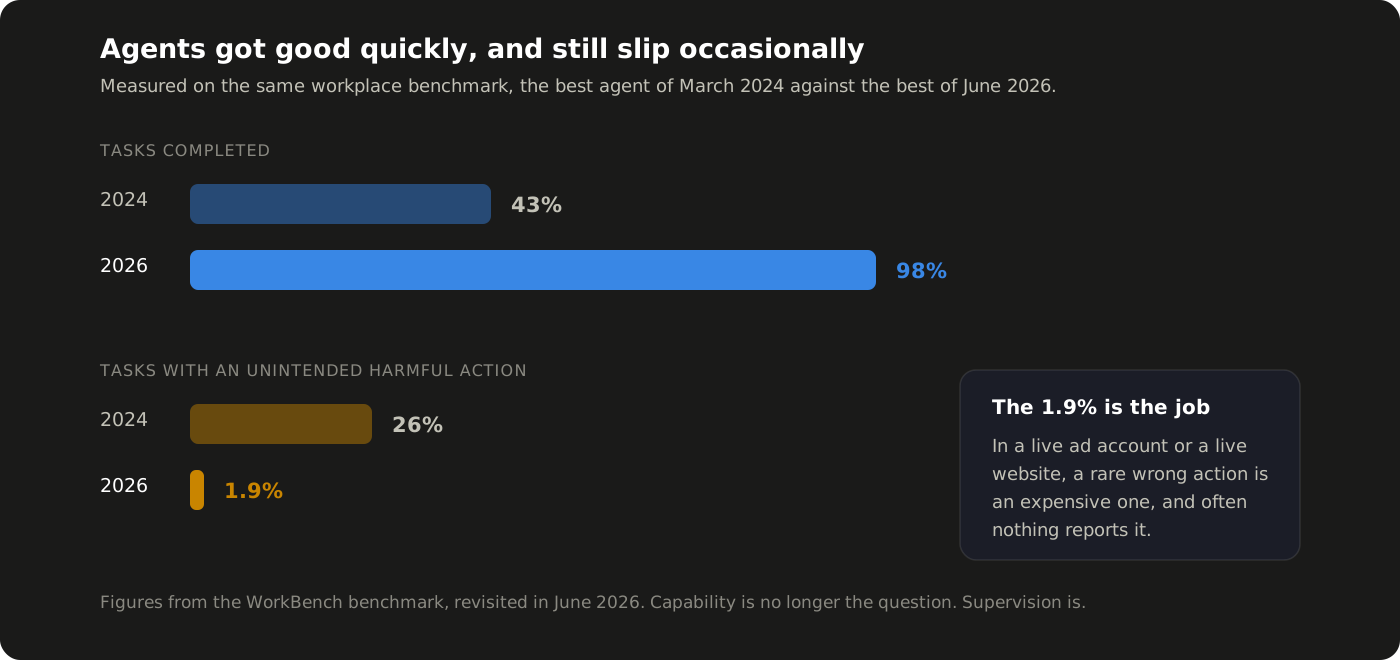
It is worth putting numbers on this rather than hand waving. In December 2024 the researchers behind TheAgentCompany, a benchmark of real office tasks, found that the most competitive agent could complete 30% of tasks on its own. Eighteen months later, a 2026 paper revisiting a similar workplace benchmark found the best agent completing 98% of the tasks, against 43% for the best model of March 2024.
That is an enormous improvement in a short time, and it ought to change how any honest agency describes its value. The parts of our trade that are mechanical, and there are plenty, are being automated in front of us.
The same paper is worth reading to the end, though. It records that frontier models still make basic mistakes that occasionally cause irreversible harm, with unintended harmful actions falling from 26% of tasks to 1.9%. For most uses, 1.9% is a rounding error. In an advertising account it is the day the budget doubles, the campaign pauses or the wrong page gets the redirect, and nobody notices for three weeks.
Somebody has to check the numbers are true
This is the one most people miss. An agent is only as good as the data it reads, and marketing data is wrong more often than anyone admits.
Here is a real example from our own reporting. For one client, a windows and doors company, Google Analytics recorded 9 form submissions in September 2026. The form system that actually receives the enquiries had 17. Analytics only counts a submission when the visitor accepted cookies and the tag fired, so on any site with a consent banner it reads low, and on a site whose tracking has recently moved it can read very low.
An agent reading that account would not have been wrong in any way it could detect. It would have seen a 47% fall in enquiries, written a confident recommendation and possibly cut the budget on a month that was actually fine. In our experience, counting enquiries at the source works better than trusting the tracked figure, because the form system and the phone bill are a record of what happened, while an analytics number is a record of what was measurable. We count them by hand for every client report for that reason.
The failures that pass every check
The second thing a person brings is suspicion. We keep an internal register of the ways a website build can fail while passing every automated test, and the entries have one thing in common. Every one of them compiles, passes its type checks, passes its linting and returns a perfectly healthy page, while being wrong.
A website that loads an image which no longer exists. A tracking tag that fires on the first page view and never again as somebody moves through the site. A contact form whose first option is disabled, so a visitor can submit nothing at all. A page that looks right and tells Google not to index it.
The expensive version of this happens quietly. On that same client's rebuild, the email address was left out of the header and footer, where the old site had carried it as a link. Email clicks fell from 14 in August to 1 in September, which accounted for 13 of the 17 fewer enquiry actions that month. No test failed. No error appeared. It surfaced because a person was reading the figures and asked why one line had moved.
Nothing errors when a website quietly stops asking for the enquiry. That is the kind of problem a person finds, because the system is not in a position to notice.
Knowing what not to do
Good marketing is mostly a series of decisions about what not to do, and that is where an agent eager to be helpful needs a hand on the tiller.
Ask one to grow your organic traffic and the obvious move is more pages, which is precisely what Google's spam policies describe as scaled content abuse, defined there as many pages generated mainly to manipulate rankings rather than to help people. Google is explicit that the problem is large volumes of unoriginal, low value content no matter how it is created, so the tool used is not the defence. We have a standing rule that a town only gets a page on our own site when we have a client actually based there, which is slower and keeps us out of that trap entirely.
The same restraint applies to the AEO packages being sold at the moment, which we went through in SEO vs AEO, and to the AI site builders we looked at in what Lovable is. A capable agent will happily implement any of it if you ask. Asking is the job.
The parts that are not tasks at all
Some of what a client pays for never appears on a task list.
Accountability. When an advert makes a claim your industry's rules do not allow, or a privacy policy does not match what the site actually does, somebody has to be answerable for it. That is a person or a company, not a model.
Access and trust. Verifying a Google Business Profile, being added to an ad account that spends real money, agreeing what a client is comfortable publishing about their own figures. All of it rests on relationships and permissions that a business grants to people it can hold responsible.
Judgement about the business, not the channel. The right answer is often that the budget is wrong, that the service page is answering the wrong question, or that the enquiries are fine and the follow up is the problem. We have told clients to spend less, and that conversation starts with knowing their business rather than their dashboard.
Someone who checks the client's own facts. When we write for a client we check what their site claims rather than just rewriting it, and on roughly one site in two that turns up a genuine factual or regulatory error in their existing content. An agent asked to rewrite a page rewrites the mistake in better prose.
How we actually use AI
Daily, and openly. It drafts, it checks, it sifts data far faster than we can, and it catches things we would have missed. What it does not do here is sign anything off, decide what a client should spend, or be the only thing that has looked at a page before it goes live. Every build goes through a pre launch audit, and every report is read by a person against the raw figures before it is sent.
That is the whole difference, and it is worth being plain about it rather than hiding behind the word bespoke. The results we report, set out in what we actually deliver, come from the same tools everyone else can buy, used by people who are answerable for the outcome.
Where to start
If you are weighing an agency against doing it yourself with AI, the useful question is not which is cleverer. It is what happens when something goes wrong, and who will notice. Ask whoever is pitching for your work how they check that the enquiry figures are real, what they will refuse to do, and who you ring when the leads stop. The same questions we suggest for reviewing your current SEO company work just as well here.
If you would like a second opinion on what your marketing is actually producing, measured against what your form system and phone have really received, our SEO and PPC work both start there. Get in touch with the team at Seonat and we will tell you what the numbers say, including when they say you do not need us.
Want this working for your business?
Tell us where you are now. We will come back with a clear picture of where you are losing ground online, and exactly how we would fix it.